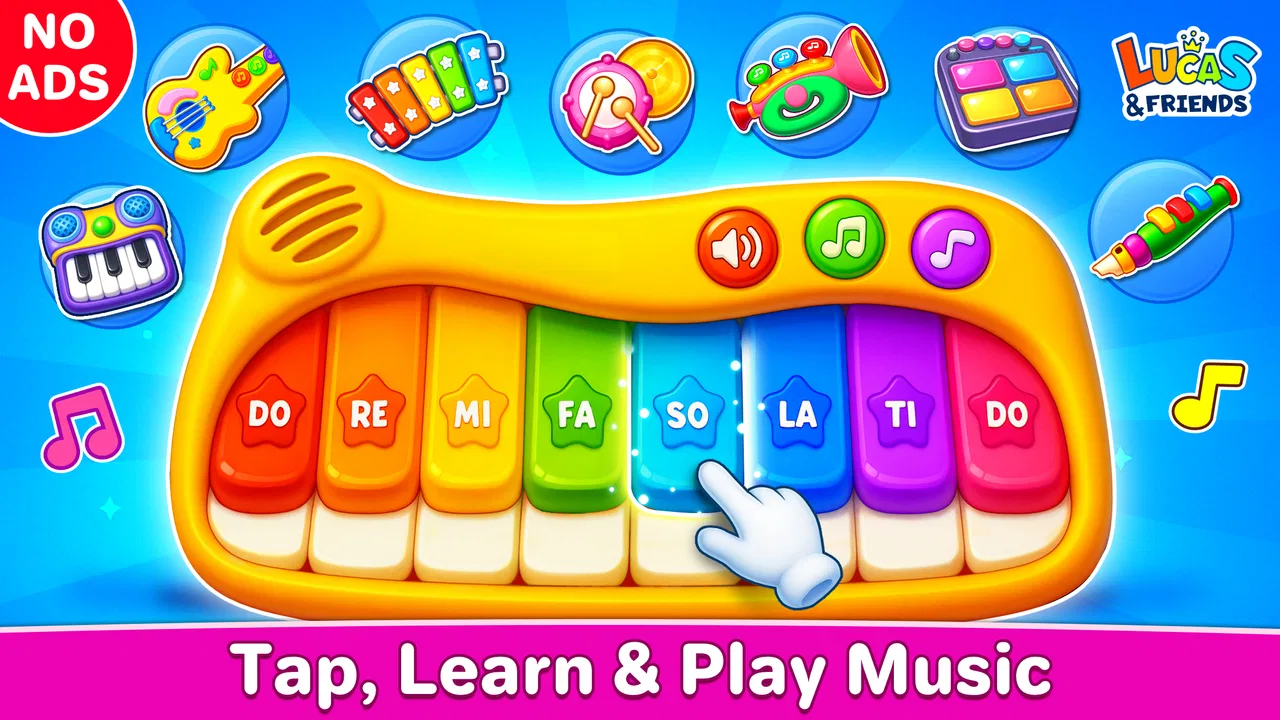
Kids Music: Piano, Xylo, Drums
- 4.3
- Rating
- 1.00M
- Installs
- Free
- Price

 Analysis by App-foxy
I spent time with Kids Music: Piano, Xylo, Drums as a simple musical game for young children, and its main appeal is easy to understand: it gives a child a small, touch-friendly space for making sounds with piano, xylophone, and drums. That focused idea matters more than a long feature list here. A toddler does not need a complicated music workstation; they need something they can touch, hear, and understand without a lesson before the first note.
This is a free game in the Music category from RV AppStudios, aimed at babies, toddlers, and kids. It is rated Everyone, works from Android 6.0 onward, and the current version is 1.1.2. The app has passed the point of being an obscure experiment, with over 500 thousand installs, although its average of 3.7 from around 800 ratings suggests that families have had mixed experiences rather than universally loving it.
My overall impression is that the app works best as a short, supervised introduction to tapping musical instruments. I would not treat it as a replacement for lessons, a serious rhythm trainer, or a full children’s music course. Its strength is the immediate cause and effect: touch an instrument, hear a sound, try another touch, and begin to notice that different parts of the screen produce different musical responses.
You May Also Like

 Blood Strike: 2.5 Anniversary
Blood Strike’s Loadouts Turn Every Drop Into a Tactical Gamble
A close look at Blood Strike’s custom loadouts: how fast access to signature weapons reshapes its battle royale rhythm, rewards preparation, and narrows the gap between fights.

 Pandora - Music & Podcasts
Pandora’s Music Is Easy to Start, but Harder to Recover
Pandora’s strength is its low-effort path from a seed to a station. Its weak spot is how much confidence it asks you to place in connection, setup, and quiet recovery.

 8 Ball Pool
 Is Built on Rivalries, Rematches, and Routine
A close look at the rivalries, rematches, shared routines, and unanswered safety questions that turn a quick pool match into a persistent mobile community.

 Samsung Music
’s Quiet Strength Is Playing What You Already Own
Its reach comes less from spectacle than from dependable access to a personal library. That simplicity is both the app’s strongest retention engine and its ceiling.

 AccuWeather: Weather Radar
AccuWeather Review: A Quick, Clear Forecast for Everyday Decisions
For everyday plans, the best forecast is the one you can understand quickly. AccuWeather makes rain timing, radar, and local conditions easy to act on, with a few trade-offs.

 Hill Climb Racing
Why Hill Climb Racing Still Turns Crashes Into One More Run
A tiny car, a bumpy hill and one more upgrade: Hill Climb Racing keeps resurfacing because its simple chaos makes every near-miss feel personal.
More From Our News Desk



The central idea: immediate instrument play
The most important capability is the direct instrument interface. Instead of asking a child to choose from a large collection of activities, the game puts the idea of playing music at the center. Piano keys suggest melody, the xylophone introduces a bright note-by-note layout, and drums invite a more physical tapping style. That variety gives a child three different ways to explore sound while keeping the basic interaction familiar.
I found this especially useful for children who are still learning that a screen can respond differently depending on where they touch it. A piano encourages moving across neighboring keys. A xylophone makes the visual relationship between bars and notes more obvious. Drums reward repeated taps and simple patterns. The result is not formal training, but it can be a gentle bridge between random screen tapping and intentional musical play.
The real value is the instant feedback between touch and sound. A young player does not have to read instructions, understand menus, or wait for a complicated activity to load before doing something. That low barrier is why this kind of app can be useful during a short quiet period, such as while a parent is preparing a meal or waiting for an appointment.
There is also a practical difference between the three instruments. The piano is the better choice when an adult wants to encourage slower exploration and individual notes. The xylophone can make note movement feel more visible and playful. The drums are likely to attract children who want energetic interaction rather than a recognizable tune. I would start with the instrument that matches the child’s mood instead of assuming every child will enjoy the same screen.
Why the limited scope helps younger players
Many children’s music apps try to combine songs, lessons, animated characters, puzzles, recordings, and rewards. That can be entertaining, but it can also bury the musical action under choices. This game’s instrument-centered design is easier to explain: choose a surface and play it. For a first encounter with digital instruments, that simplicity is a genuine advantage.
The trade-off is that the experience may feel too narrow for an older child who already knows how to play melodies or wants structured challenges. There is a difference between making sounds and learning an instrument. This app is much closer to the first experience. Parents should set expectations accordingly, especially if they are looking for lessons, notation, practice goals, or a way to build measurable technique.
How playing feels in everyday use
When I use a game like this with a young child, the most useful approach is not to hand over the device and expect a long session. I would sit nearby, name the instrument, and give one small prompt: “Can you find a higher sound?” or “Can you tap a slow beat, then a fast beat?” Those prompts turn the app from a noise generator into a shared activity without making it feel like homework.
A realistic scenario would be a preschooler becoming restless during a short wait. I would open the piano first and let the child explore freely for a moment. Then I might switch to the xylophone and ask the child to move from one end to the other, listening for the change in pitch. If the child starts tapping rapidly, I would move to the drums and use that energy to create a simple call-and-response game: I tap a short pattern, and the child tries to answer.
That workflow is more valuable than simply leaving the game running. It uses the different instruments for different kinds of attention: the piano for individual notes, the xylophone for comparing pitch movement, and the drums for rhythm and repetition. Even without formal teaching tools, an adult can create a small progression that feels natural to a child.
One useful tip is to keep sessions short when the child begins tapping without listening. At that point, more screen time is unlikely to add much. Closing the app and returning later can preserve the sense that playing music is an activity rather than background noise. This is also where supervision matters: the game is suitable for children, but the device itself may contain other apps or settings that are not part of the musical experience.
Another practical tip is to use the game with the sound at a comfortable level rather than treating louder audio as more exciting. Young children can become absorbed in repeated tapping, especially on the drums. A moderate volume makes it easier for the adult and child to talk about what they hear, and it keeps the activity from turning into an overwhelming burst of noise.
Turning free play into a small learning moment
I would not claim that a few minutes with virtual instruments teaches a child to play piano, xylophone, or drums. What it can do is support early listening habits. Ask the child to notice whether two taps sound the same, whether a pattern repeats, or whether a note changes when they touch a different area. These questions encourage attention to sound without requiring musical vocabulary.
The xylophone is particularly useful for this kind of conversation because its layout naturally suggests movement across separate bars. A parent can invite the child to make a pattern using two or three positions, then repeat it. The goal is not accuracy in a formal sense; it is helping the child notice sequence and repetition.
The drums offer a different opportunity. They can support simple rhythm games based on pauses. I would tap twice, wait, and tap once, then invite the child to copy the pattern. If the child cannot copy it, that is fine; the pause itself becomes something to notice. This is a more thoughtful use of the app than encouraging constant rapid tapping, and it requires no invented scoring system or reward structure.
With the piano, I would focus on contrast rather than trying to teach a song. Ask the child to find a low-sounding key and then a higher-sounding key, or to play two notes slowly. This keeps the activity exploratory and avoids promising a level of instruction the game is not designed to provide.
The best setting for this game
The strongest setting is a shared parent-and-child session lasting only as long as the child remains curious. It can fit into a calm indoor routine, a brief waiting period, or a first introduction to the idea that instruments are made of separate playable parts. The app is especially suitable when the child wants to touch and experiment, but is not ready for a structured lesson.
I would be less enthusiastic about using it as an unattended distraction for a long stretch. Musical sound can keep a child occupied, but occupation alone is not the same as meaningful play. The game becomes more rewarding when an adult occasionally names what is happening and helps the child compare sounds.
It can also work as a transition activity. For example, a parent might allow a few minutes of drum play before moving to a quieter routine, then finish with slower piano taps. That gives the session a natural change of energy. The instruments are not just three interchangeable buttons; they can help an adult guide the mood of the interaction.
Where the experience falls short
The biggest limitation is the gap between immediate fun and lasting depth. A child can understand the basic idea quickly, which is excellent for accessibility but may reduce replay value for children who want progression. Without a stronger sense of challenge, older kids may move on after the novelty of tapping the instruments fades.
The 3.7 average rating is a useful reminder to keep expectations realistic. It does not make the game a poor choice, but it suggests that the simple concept will not satisfy every family. Some children will enjoy open-ended sound play; others will want songs to follow, levels to complete, or clearer goals. If your child asks, “What do I do next?” after trying each instrument, a more structured music-learning app may be a better fit.
There is also a trade-off between simplicity and control. A direct touch interface is friendly to toddlers, but it does not automatically teach timing, pitch accuracy, or hand technique. A real child-sized instrument offers physical feedback that a screen cannot fully reproduce. If the goal is to prepare for actual piano, xylophone, or drum practice, I would use this game as a supplement to real objects, not as the main tool.
Parents should also consider the child’s temperament. A child who enjoys repetitive sound may find the drum section exciting, while another may become overstimulated. The piano or xylophone can provide a calmer alternative, but the app is still an audio-focused activity. I would introduce it when the child can handle interactive sound, not during moments when the household needs complete quiet.
Compared with a music video, this game has the advantage of making the child an active participant. A video demonstrates music while the child watches; this app lets the child cause the sound. Compared with a real instrument, however, it offers less tactile depth and no physical practice with keys, bars, or drum surfaces. Compared with a formal learning app, it is easier to start but much lighter on structure.
That comparison helps define its proper place. Choose this game over a video when you want hands-on exploration. Choose a real instrument when physical technique matters. Choose a lesson-based app when the child is ready for progression and deliberate practice. The game sits comfortably between passive entertainment and formal instruction.
Device and family considerations
The game is free, which makes it easy to try without committing money first. It is suitable for Everyone and supports Android 6.0 or later, so it can work on many older Android devices still used as family or children’s tablets. I would still test it on the actual device before planning a longer activity, because a child’s experience depends on how responsive and comfortable that particular screen feels.
Its current version is 1.1.2, and the developer is RV AppStudios. Those details are useful when checking that the installed copy is the intended game, particularly on a shared device where several children’s apps may have similar names. I would also place the device in a stable position and remove unnecessary distractions before handing it to a toddler; the quality of the interaction depends as much on the setup as on the game itself.
The audience label is broad, but “Everyone” should not be read as a promise that every age group will find the same value. A toddler may enjoy cause and effect, a preschooler may respond to copying patterns, and an older child may quickly want more direction. The younger the child, the more important it is for an adult to guide the session and prevent random tapping from becoming the only form of play.
Who gets the most from it
I think the best match is a parent looking for a first digital music activity that can be started immediately. It is also a good option for children who are curious about instruments but are not ready to sit through a lesson. The three instrument styles give families a way to discover whether a child responds more to melody, visible note movement, or rhythm.
It can be useful for siblings as a short shared activity, although I would avoid expecting cooperative play automatically. Two children may want the same instrument or may simply create competing sounds. An adult can make it work by assigning turns or asking one child to make a pattern while the other listens. That turns a possible source of frustration into a basic listening game.
I would skip it if you need a curriculum, song tutorials, recording tools, detailed rhythm exercises, or a clear path from beginner to advanced play. I would also look elsewhere if your child already has regular access to a real instrument and wants to improve technique. In those cases, the game may feel more like a toy than a useful practice companion.
For everyone else, the decision is fairly simple: install it when you want low-pressure musical exploration, and approach it as a short activity rather than a complete education product. The free price removes much of the risk of trying it, while the modest rating suggests that expectations should remain grounded.
After using it, I see Kids Music: Piano, Xylo, Drums as a focused starter game rather than an all-purpose music app. Its strongest feature is the direct connection between a child’s touch and an instrument-like sound. Used with a little guidance, that connection can support curiosity, listening, pattern play, and a first sense of musical choice.
My recommendation is positive for babies, toddlers, and younger children who enjoy experimenting with sound, especially when a parent or caregiver joins for a few minutes. I would not recommend it as a substitute for real instruments or structured lessons. Its value comes from being approachable and immediate, and that is enough when the goal is simply to help a child discover that making music can begin with one small tap.
FAQs for Kids Music: Piano, Xylo, Drums
01What age group is Kids Music: Piano, Xylo, Drums suitable for?
Kids Music: Piano, Xylo, Drums is designed for children aged 3 to 8 years old. The app provides a playful introduction to music through various instruments like piano, xylophone, and drums. It's engaging and colorful interface is perfect for young learners, encouraging exploration and creativity in a safe, ad-free environment.
02Does Kids Music: Piano, Xylo, Drums require an internet connection?
No, Kids Music: Piano, Xylo, Drums can be enjoyed offline. Once the app is downloaded and installed, it does not require an internet connection to use the features. This makes it an excellent choice for long car rides or situations where internet access may be limited.
03Are there in-app purchases or ads in Kids Music: Piano, Xylo, Drums?
Kids Music: Piano, Xylo, Drums is designed to be child-friendly, meaning there are no ads to interrupt the experience. However, there may be in-app purchases available to unlock additional features or instruments. These are secured behind a parental gate to prevent unauthorized purchases by children.
04How does Kids Music: Piano, Xylo, Drums support child development?
The app supports child development by fostering creativity, improving motor skills, and enhancing auditory recognition. By interacting with different musical instruments, children learn rhythm, sound differentiation, and basic musical concepts. It also encourages fine motor skill development through tapping and swiping on the screen.
05Is Kids Music: Piano, Xylo, Drums available on both Android and iOS?
Yes, Kids Music: Piano, Xylo, Drums is available for download on both Android and iOS platforms. It can be found in the Google Play Store for Android devices and the Apple App Store for iOS devices, ensuring accessibility to a wide range of users regardless of their device preference.
Pros
- Engaging interface for kids.
- Wide variety of instruments.
- Easy to navigate for children.
- Educational and fun gameplay.
- No ads interrupting play.
Cons
- Limited song selection.
- Requires in-app purchases.
- No offline mode available.
- Graphics could be improved.
- Sound quality varies.

Kids Music: Piano, Xylo, Drums
Gallery